Tuesday, November 6, 2012

A Patient with Watering Eye after Road Traffic Accident

Malposition of the eyelid(s) following road traffic accident is a common referral to my eyelid clinic. Most of these patients are motor cyclists.
This patient complains of discomfort and watering in his left eye one month after motorcycle accident. Examination reveals skin contracture and out turning (ectropion) of the lower eyelid. CT scan showed compounded fractures of the facial bones. The eyelid appearance is caused by a combination of skin loss and tissue entrapment in the fractured bones.
Contracture of the lower eyelid skin causing eversion
of the lower eyelid.
There are several methods of correcting the malposition. The method I employ is a rotation flap using the skin from the upper eyelid. The discomfort and watering are significantly reduced at one month follow-up. Further surgery may be needed later to reconstruct the facial bony fractures.
a. Marking of the upper lid; b. Release of the lower lid skin scar
c. Creation of the rotation flap; d. Rotation flap in place
e. End of th surgery and the lids are closed together
to prevent skin contracture; f. Appearance the second day.


Improved lid position at 4-week follow-up.

Sunday, November 4, 2012

A Patient with Problem Closing His Eye after Road Traffic Accident

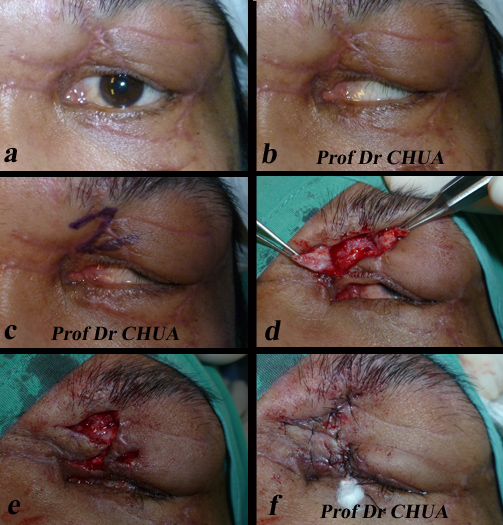
This motor biker was involved in a road traffic accident resulting in loss of his upper eyelid skin. The repair performed in the emergency room did not replace the lost skin and the patient was left with difficulty in closing his left eye which gave him constant eye pain and blurred vision.
Left upper lid contracture from skin loss resulting
in closure problem.
He was referred to the eye clinic for further management. On examination, there was skin shortage resulting in left upper lid skin contracture. I performed a Z-plasty to lengthen the eyelid vertically and the lid closure improved.

Steps taken to correct the contracture.
a. and b. before the operation.
c. marking of the z-plasty;
d. creation of the z-plasty and release of scar tissue;
e. the contracture released with good eye closure;
f. at the end of the procedure, the upper and lower
eyelids were tied together for five days
 to prevent skin contracture.
 
 
3 weeks after the operation. The upper eyelid had been
 lengthened vertically and the eye closure improved.

Monday, October 29, 2012

Case 7: Doctor, Why Are My Double Eyelids Unequal?

Fat in the upper eyelid contributes to fullness of the lids. During double eyelid surgery, some of these fat are usually removed to allow better adhesion between the skin and the underlying tissue. However, if too much of this fat were removed, the upper eyelid may appear hollow and worse still some patients may develop multiple skin creases above the double eyelid. Therefore, experienced surgeon knows the importance of not aggressively removing the fat.
 
Sunken and hollow upper eyelid caused by excessive fat excision.
Also note the extra lines above the double eyelids.

Diagrams showing what happens when too much fat is removed.
a. Normal contour of double eyelid after procedure
b. Too much fat removed (red arrow) causing depression (hollow) upper eyelid
c. To overcome this problem the fat compartment needs to be pumped up (blue areas)
with either fat or substitutes such as hyaluronic acid.
 
 
The way to treat an eye that have too much fat removed is to replace the volume. This can either be fat transfer from other part of the body or using substitue such as fillers. The best filler with good safety record is hyaluronic acid.
 
Picture showing left sunken socket and extra lines due to fat depletion.
Hyaluronic acid was injected into the depressed area (arrows)
to pump up the sunken area and removed the extra lines.
(the last picture was taken immediately after injection)
 
Another patient with too much fat removal causing left sunken lid.
The lower picture was taken a few days after hyaluronic acid injection.


Sunday, October 28, 2012

Case 6: Doctor, Why Are My Double Eyelids Equal?

Amongst East Asians (Chinese, Japanese and Korean), unequal double eyelids appear to be common in the normal population. Most cases are caused by poor attachment between the skin and the levator muscle in one of the eye. A study performed in Korea showed a prevalence of unequal double eyelids (in which one eye had double eyelid and the other without) is about 10.9%.
 
Song WC; Kim SJ et al. Asymmetry of the palpebral fissure and upper eyelid crease in Koreans. Journal of Plastic, Reconstructive & Aesthetic Surgery (2007); 60, 251-255


The eye without the double eyelid tends to appear smaller because of the eyelid skin hanging over the lid margin. This may sometimes be misdiagnosed as droopy eyelid. Treatment is to create a double eyelid similar in height to the eye with the double eyelid.
 
This patient was born with absent right upper skin crease. Over the year, she had been using glue and tape to create a double eyelid but find it time-consuming. She wanted a right double eyelid with minimal down time. I performed a DST (double suture twisting technique), the result appears satisfactory at one week follow-up without noticeable swelling.
 
Right double eyelid creation using DST.
 

Thursday, October 25, 2012

Case 5: Doctor, Why Are My Double Eyelids Unequal?

To prevent the loss of double eyelids (skin creases) or ones that are shallow, it is important to create good adhesion between the levator muscle and the orbicular muscle and skin (photos showing the procedure). However, several factors may prevent this from happening and these factors may be divided into surgeon and patient factors.
 
Surgeon factors:
  • Failure to clear adequate amount of tissue between the skin and the levator muscle.  This can interfer with correct adhesion between the structures.
  • Inadquate anchoring of tissue between the orbicularis/skin and the levator muscle. There should be adequate area of contact between these tissues or the skin creases can easily disappear with time.
 
Patient factors:
  • Excessive postoperative swelling. Prolonged swelling will affect the adhesion between theskin and the levator muscle.
  • Failure to take care of the lids. Excessive rubbing of the eyelids can loosen the adhesion.
This patient presented with asymmetrical double eyelids. The left double eyelid is well-formed but that of the right one is shallow. This is due to inadequate adhesion between the levator and the skin.
 
Shallow right double eyelid.
 
There are several ways of recreating the adhesion: either by incision or suture technique. With the incision technique, the skin crease need to be incised along its length and the tissues resutured, however, this can create significant post-operative swelling in lid that had had surgery before. I opted for the suture technique and the post-operative result appeared satisfactory at two weeks.
 
Steps in suture technique to deepen
the double eyelid.
 
Postoperative appearance.


Monday, October 22, 2012

Case 4: Doctor, Why Are My Double Eyelids Unequal?

Postopertive swelling is a common cause of asymmetrical double eyelids (skin creases). This occurs especially in patients who needed more tissues (skin, muscle or fat) removed from one eye than the other. The swelling is usually worst on the first post-operative day. Cold compress to the upper eyelids  every 2 to 3 hour (each time for about 10 minutes) can significantly reduced the swelling. Depending on the extent of the procedure, the swellings may take one week to a few weeks to subside.
 
This patient (see pictures below) had excess upper eyelid skin and eyebags. She had excision of the excesss upper eyelid skin and fat and extended lower eyelid surgery. Because of the extent of the procedure, there was significant swellings the next day causing asymmetry of the eyelids. With cold compress, the swellings and hence the asymmetry improved after one week and continued to do so with time.
 
a. Before the operation;
b. 24 hours post-operation;
c. one week post-operation and
d. two weeks post-operation.
 

Saturday, October 20, 2012

Case 3: Doctor, Why Are My Double Eyelids Unequal?

Another cause of unequal double eyelids is unrecognized ptosis (droopy eyelid as a result of weak muscle) before surgery. Therefore, it is important for surgeons to make sure that the two eyes are the same size before double eyelid surgery to avoid any post-operative surprises.
 
This young woman underwent double eyelid surgery three months ago but had been trouble by unequal heights of the double eyelids being significant higher on the right. Examination revealed mild right ptosis with good eyelid function.
 
Right double eyelid higher due to ptosis.
 
Good function of the muscle moving the eyelid.
 
The treatment of choice in this case is to advance the muscle that moves the eyelid (levator muscle) so that right double eyelid is the same height as that of the left. I used the posterior approach method of advancing the levator muscle. This technique has the advantage of not cutting through the skin so that the down time is shorter.
 
Posterior approach ptosis repair.

Pre (I) and post (II) operative repair of
the right ptosis.