Tuesday, January 5, 2016

What the Nurse Really Means when She Says All Surgeons are the Same

I overheard a conversation between a nurse and a patient at the cataract clinic.

Patient:” Nurse, are you sure the surgeon who is going to operate on me next week is good? Can you ask a good one to operate on me?”

Nurse: “All the eye doctors here are the same, they are equally good. No to make choices!”

I looked across the room and noticed it was the same nurse who asked me to operate on her father several years ago. Her father was scheduled to be operated by a senior surgeon but two days before the surgery the senior surgeon fell sick and took a one-week sick leave. Her father was rescheduled to be operated by a different surgeon.

Nurse:” Doc, could you go into the theatre tomorrow to operate on my father?”

I:”I thought doctor X is going to do the operation!”

Nurse:”But I am scared that the result would be bad.”

I:”How do you know?”

Nurse: “I have seen his operations, he is very rough with the patients and has lots of complications.”

I:”But I would upset him if I went in during his list, I am sure you can find some excuses to delay the operation until the senior surgeon returns.”

The nurse duly informed the doctor in-charge of the operating list that her father had persistent cough and could not have operation the next day.

Lessons:

1. Not all surgeons are the same, the nurses know best even if they don’t want to say it.

2. While it is complimentary to be regarded as a better surgeon, never upset your colleague by taking away his/her patient.


3. For elective surgery, there is no need to compromise on outcomes by subjecting your loved one to less able hands.

Monday, January 4, 2016

Doc, can you do anything to my son's eyes to stop the bullying ?

Children are cruel and often like to bully their classmates who have facial imperfection despite the threat of punishments from school authorities. This boy had been bullied for many years because of his droopy eyelids and right squinting eye (he has an exotropia in which the eye turns out). 

Bilateral droopy eyelis and a right eye that turns out.

His mother noticed that his school performance has been deteriorating steadily due to the bullying. She enquired if anything could be done to correct the defects. Examination revealed normal vision in both eyes and the right eye was able to take up fixation rapidly when the left eye was covered. Both eyelids had good functions. Surgery was perfromed under general anaesthesia to correct the squint, droopy eyelids (ptosis) and simultaneous creation of double eyelids. Post-operatively, the boy regained his confidence and the bullying stopped.

The right squint was corrected vai right lateral rectus recession and left medial 
rectus resection. The ptosis and double eyelids were corrected by posterior approach
 conjunctivomullerectomy and suture techniques respectively.  

Before and 2-month post surgery. 


Saturday, January 2, 2016

Doc, can you do something about my weird looking eye?

This patient underwent bilateral blepharoplasty and right ptosis surgery a few months ago. She complained the right eye appearing weird and had difficulty opening the left eyelid.


Examination showed that the right eye had poor contour with the highest point of the upper eyelid too far to the temporal side. In addition, there was slight droopy of the eyelid nasally.

The high point should be at the site of red arrow but in this patient, 
the highest point is at the white arrow

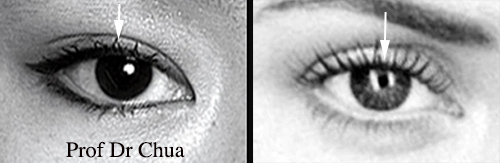
In Chinese eye, the highest point of the upper eyelid is usually just temporal to the pupil (in Western eye, the highest point corresponds to the centre of the pupil).  The patient's left eye also had undiagnosed ptosis which was not corrected. 
A Chinese eye (right) versus a Caucasian eye showing the highest point 
of the eyelid in Chinese is slightly temporal to the pupil. 

To correct the poor contour, the nasal side of the eyelid had to be lifted. This was achieved by by posterior approach conjunctivomullerectomy. The left ptosis was also corrected the same time using the same posterior approach. 


Before the operation, makings (in blue) were make for anchoring the sutures 
so that the highest point was just temporal to the pupil.

Steps showing the procedure for the right eye. a. The right eyelid was everted; 
b. a horizontal cut was made at the upper border of the tarsal plate, 
the cut corresponded to the distance between the two markings; 
c. Scissors were used to make vertical cuts to produce a strip of 10mm 
conjunctivomuller flap; d. the strip was cut and e. 2 nylon sutures were used to attached 
the cut ends to anterior surface of the tarsal plate; f. at the end of the procedure, 
the highest point has now been shifted nasally.

At the end of the operation, the left ptosis was also corrected.


Friday, January 1, 2016

Doctor, can you remove these lumpy things from my eye?

This young man presented with these lumpy lesions of his right eye for the past 3 months. He has had similar condition 6 months earlier and consulted a different eye doctor. The lesions were excised at that time without further treatment and they returned with a vengeance. 

Conjunctival papillomas affecting the upper and lower tarsal conjunctiva.

Examination revealed multiple pendunculated lesions arising from the upper and lower tarsal conjunctiva and the patient had problem shutting the eye properly. The lesions are typical of conjunctival papillomas. These lesions are benign and are associated with huma papillomavirus (HPV) infection. Although they can be excised easily, recurrence is common unless adjunctive therapy was performed. 

In this patient, the lesions were excised followed by application of 0.01% of mitomycin to the bases for one minute. So far, the patient showed no recurrence at follow-ups. 

The upper eyelid was everted with Desmarres retractor to fully 
expose the affected tarsal conjunctiva.

The lesions were excised using a blade and the bases scrapped clean.

Cotton bud dipped in 0.01% mitomycin was applied to the bases 
for one minute.

At follow-up, there was no recurrence.

At follow-up, the tarsal conjunctiva appeared free of papilloma.


Reference:
Conjunctival papilloma: features and outcomes based on age at initial examination. Kaliki S, Arepalli S, Shields CL, Klein K, Sun H, Hysenj E, Lally SE, Shields JA. JAMA Ophthalmol. 2013 May;131(5):585-93.

Friday, December 18, 2015

Launch of New Book for Sarawak Heart Foundation

I am pleased to announce the publication of the new book "Picture Diagnostic Tests for Postgraduate Medicine" today. The book was written with the help of the Ophthalmology and the Cardiac Department and published by my company Marudi Publication. All proceeds from the sale of the book will be donated to the Sarawak Heart Foundation.

  
Lauching the book with Prof Sim (right) and Dr Koh (left).


The book is now available from the Sarawak Heart Foundation
 in the Heart Centre.

Wednesday, October 14, 2015

Excision and reconstruction of a Lower Lid Lesion

This man was concerned about his lower eyelid xanthelasma which had troubled him for the past 10 years and had got bigger. He had tried trichloroacetic acid and laser treatment but without success. The lesion was excised closed to the margin and a rhomboid flap was used to cover the defect.
(Special thanks to Dr Ho Shu Fen, Dr Chin Ong and Dr Andy Yew for assisting the operations and taking the pictures).
Steps showing the excision of the xanthelasma and use of rhomboid flap to cover the defect. The main concerns in this procedures are lower lid ectropion (eversion of lower lid) and scarring. The former requires the use of flap that does not cause too much tension on the lower lid margin and the later needs meticulous suturing technique to minimal scarring. 

Thursday, October 1, 2015

Excisional Biopsy of a Lower Eyelid Basal Cell Carcinoma

This patient had a lower eyelid ulcer for the past year. The appearance was typical of basal cell carinoma, an excisional biopsy was done with 3mm clear margin. A rotational flap was used to cover the defect as shown.