Sunday, May 12, 2019

Tumour Excision and Reconstruction

This 70-year-old woman had an expanding lower lid lesion for the past three years. Initially, she ignored it until it started to bleed and causing irritation. Biopsy confirmed cell carcinoma. The lesion was excised in total and reconstructed using nasojugal flap. The bottom picture was taken about two months later.


Lower Lid Reconstruction after Tumour Excision

This renal dialysis patient had a rapidly growing left lower lid lesion that destroyed the lower eyelashes. Biopsy by dermatologist showed it to be a squamous cell carcinoma. Complete excision was performed followed by Tenzel’s flap reconstruction.


Reconstruction of Lower Lid from Windscreen Injury

This patient had right cicatricial ectropion from car windscreen injury. The pictures below was taken immediately post-reconstruction.


Thursday, February 28, 2019

Combined Double Eyelids and Epicanthoplasty


This young woman wanted her eyes to look bigger and less tired. The middle photo shows the height that the patient desired. The bottom photo was taken three weeks after Asian blepharoplasty (double eyelid surgery) and epocanthoplasty (using skin redrawing technique).#asianblepharoplasty #doubleeyelid#doubleeyelidsurgery #epicanthoplasty #双眼皮手术 #双眼皮 #开眼角 #drchuachungnen#eyelidsurgery #蔡鐘能眼科医生 #optimaxpenang#ttdioptimax #kleyelid #sibuisec #kichingoptimax#miricolumbiaasia

Multiple Eouble Eyelids Corrected by Lifting the Eyelids


This middle-aged woman was bothered by her multiple skin creases in the upper eyelids and asked for Asian blepharoplasty (double eyelid surgery). However, examination revealed the underlying cause was droopy eyelids (ptosis) and Asian blepharoplasty will only create unnaturally high skin creases (double eyelids) and sleepy look. Instead bilateral posterior approach ptosis correction was performed. At two weeks follow-up (bottom picture) the multiple skin creases not only disappeared by the eyes also appeared more alert.

Wednesday, November 28, 2018

Epicanthoplasty to make the eyes bigger


Just done 6 eyelid operations for the day. In addition to removing the epicanthus (the excess skin that cover the nasal side of the eye), epicanthoplasty also lengthens the eyes and make the eyes appear bigger. There are several ways to perform epicanthoplasty and some methods create more scars than others, the one I prefer is skin redraping procedure which leave inconspicuous scars along the lid margins. This young woman under such technique, the first picture was taken before the procedure, the middle one immediately after the operation and the bottom 10 days later. #epicanthoplasty #双眼皮 #开眼角 #蔡鐘能眼科医生 #眼角 #epicanthus #blepharoplasty #eyelengthening #skinredraping #doubleeyelidsurgery #drchuachungnen #isecsibu #kuchingoptimax #ttdiopyimax #kliptimax #penangoptimax #miricolumbiaasia #sarawakeye #malaysiaeyelids #malaysiaeyelidsurgery #kuchingeyespecialist #sibueyespecialist #mirieyespecialist #oculoplastic #eyespecialist

Thursday, August 30, 2018

Double Eyelids for a 5-year-old Boy


Not all double eyelid surgery (Asian blepharoplasty) are done for aesthetic purposes. This 5-year-old boy had a long history of eye irritation and blurred vision. Examination showed ingrowing eyelashes exacerbated by his puffy eyelids and lack of skin creases (double eyelids). I created low skin creases (for boys double eyelids should be made low and girls higher) and everted the eyelashes. The creation of skin creases (double eyelids) not only made the eyes appear bigger but also prevent the upper eyelid skin from coming over the eyes and push the eyelashes inwards. The operation was done under general anaesthesia and the lower pictures were taken 6 months later.

Monday, August 20, 2018

An elderly man with droopy eyelids

This 75-year-old had ptosis (droopy eyelids due to weak levator muscles) since since young. He did not seek help as he was able to see by lifting his head slightly. However, over the last 5 years, he was unable to see well even by lifting his chin by 45 degrees. This was because the ptosis has been compounded by dermatochalasis (droopy eyelids due to excess upper eyelid skin). To improve his vision, bilateral upper blepharoplasty was combined with frontalis suspension. The bottom picture was taken at 4 weeks follow-up. 


Tuesday, July 24, 2018

20 Minutes to Correct Triangular-shaped Eyes


This young man was unhappy with the shape of his eyelids which made him look tired and uninterested. To make the eyes appear more animated without making the skin creases too high. Bilateral suture techniques were done and the creases set at 6mm. The lower picture was taken 10 days after the procedure.

Monday, June 25, 2018

Advantages of Posterior Approach Ptosis Operation for Mild to Moderate Ptosis

I

I saw this 70-year-old man yesterday who had had trouble opening his right eye for the past 5 years. The levator function was 10mm in the right eye and 13 Mum in the left eye. The ptosis occluded his right visual axis making driving difficult due to the lack of binocular vision. The eyelid did not open in response to mydfrin (2.5% phenylephrine). A posterior approach levator advancement was performed with good result. The bottom picture was taken this morning. Two of the great advantages of posterior approach ptosis correction is fast recovery and no need for suture removal.

Friday, February 2, 2018

Relationship between skin crease and ptosis surgery


The show of double eyelids (the amount of double eyelids visible when the patient look ahead) after ptosis correction is best illustrated in this patient. This patient had bilateral droopy eyelids and multiple skin creases (top picture). However, she attributed her sleepy appearance to indistjnct double eyelids. When the droopy eyelids was pointed out to her she agreed to have ptosis correction via posterior approach. The double eyelid heights were set at her original skin creases at about 7mm (middle photo, the blue dots indicate the height of the skin crease set). After the operations, she no longer appeared sleepy but was unhappy that her double eyelids were barely visible. The reason for this is because the patient had associated dermatochalasis (excess skin) which covered the skin creases (double eyelids). To make the double eyelids visible, the excess skin above the skin crease need to be excised for this patient. 

Wednesday, January 24, 2018

Ptosis may present as multiple and indistinct double eyelids


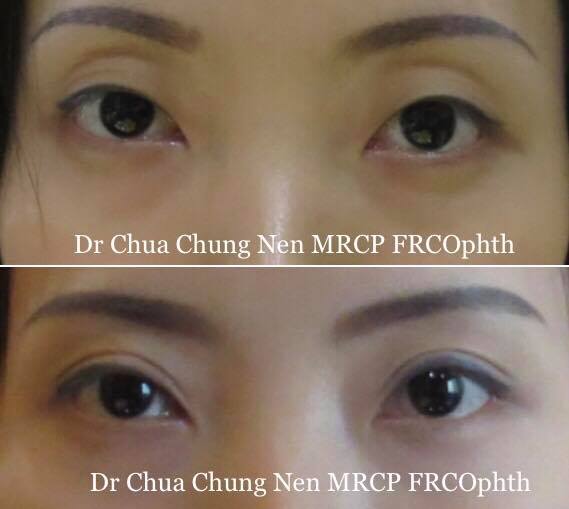
Although patients with ptosis usually complain of droopy eyelids or tired looking eyes, some may present with multiple skin creases (double eyelids, red arrow) or sunken upper eyelid (sunken sulcus, blue arrow). It is important for doctors to detect Ptosis in such patients otherwise double eyelid surgery or filler injection may exacerbate the ptosis. This patient who was a contact lens wearer complained her natural double eyelids (skin creases) were faints and multiple (top picture). She asked for double eyelid surgery. However, examination showed she had bilateral ptosis and creation of double eyelids would only make the eyes more droopy and tired (middle photo). Posterior approach ptosis correction was done and the patient was happy that she looked more alert and the multiple skin creases and sunken sulcus were also corrected (bottom picture taken one week after ptosis correction).

Monday, January 22, 2018

Transient eyelid asymmetry after ptosis correction


This patient also had contact lens induced left ptosis (droopy eyelid, top picture). Correction of the left ptosis resulted in droopy of the right ptosis which alarmed the patient (middle picture taken at one week after posterior approach ptosis correction). Two main factors may be responsible for this phenomenon: a. The patient had ptosis in both eyes with one eye being more severely affected. Therefore, successful correction of one eye will bring out the contralateral ptosis. b. The ptotic eye was overcorrected resulting in the opposite eye becoming droopy. However, most oculoplastic surgeons usually overcorrect droopy eyelid slightly so that any drop of the eyelid during recovery will be compensated. 
As this patient did not have right ptosis before the operation, the most likely cause for the imbalance is factor b and she was reassured. At 6 weeks follow-up the two eyes were nearly symmetrical (bottom picture).


Another patient with contact lens induced ptosis


Another patient with contact lens induced ptosis. The left ptosis was also corrected with posterior approach correction which is the preferred method as the down time is minimal. The bottom photo was taken 5 days after the operation.

Wednesday, January 17, 2018

Contact lens induced droopy eyelid (ptosis)


Contact lens wear (both hard and soft) is a known risk factor for Ptosis (droopy eyelid) in people under age of 35. The reasons may be : a. Stretching of the eyelid during contact lens insertion and removal and b. Low grade inflammation from contact lens may weaken the eyelid structure. This 35-year-old woman had been a contact lens wearer for over 20 years in the past 2 years she noticed the left eye had become progressively more droopy. Examination showed no neurological causes and a posterior approach ptosis correction restored the lid to the desirable level (bottom picture taken at two weeks post surgery). For more information, click here for contact lens induced ptosis

Tuesday, January 16, 2018

Droopy Eyelid (Ptosis) after Double Eyelid Surgery


This young woman had double eyelid surgery performed in a beauty saloon by a visiting China “doctor” . Postoperatively she noted the right eye to be droopy in the medial two third of the upper lid. She returned to the “doctor” and was reassured that it will correct itself in a few months. But the droopiness persisted. When she returned to the beauty saloon, the owner of the centre told her the “doctor” would not return and asked her to see the new visiting “doctor”. The later told the patient that she was unable to correct the droopy eyelid and asked her to seek help in “proper” medical centre. On examination, she appeared to have damage to the medial 2/3 of her levator aponeurosis. Posterior conjunctivomullerextomy was performed with good outcome (bottom picture taken at one month postoperative).

Tuesday, December 26, 2017

Multiple Stones in a Woman's Lower Lids

This 60-year-old woman complained of swelling of the medial lower eyelid with discharge. Examination revealed inflammation of the lower canliculus with pus. The canal oculus was incised and curretaged multiple yellow concretions were expressed. The canaliculus was irrigated with antibiotic and treated with iodine application. This was a case of chronic canaliculitis caused by the bacteria Actinomyces Israeli. 


Friday, December 22, 2017

Social implication of eyelids

Eye contact accounts for 90% of face-to-face communication, it’s little wonder that any imperfection of the eyelids can create a negative impression which can affect one’s social life including career prospect. This 25 year-old insurance agent complained that despite his qualification and selling skills, his clients regarded him as distant and uninterested. He attributed this to his heavy eyelids and narrow eyes which gave him an expressionless face. I created 6mm double eyelids for him with fat removal to reduce the heaviness of the upper lids. The picture at the bottom was taken one-month later, he was pleased with the results and did not return for further follow-up. I assume he was too busy with his clients to return 😀.


Thursday, December 21, 2017

Treatment of sunken upper eyelid without filler or fat injection.

A 23 year-old woman complained of sunken upper eyelids and absence of skin creases (double eyelids) which made her looked tired and older. She had consulted another doctor who recommended filler or fat injection. However, she was concerned that the injection may not last and the associated period of post-injection swellings. I performed bilateral double eyelid surgery with simultaneous posterior conjunctivomullerectomy to widen the eyes and pulled forward the fat to fill the sunken areas. The picture below was taken 2-month postoperative.


Thursday, August 24, 2017

Doc, Can You Show Me Pictures of How You Do Incisional Double Eyelid Surgery?

In my experience, most patients who wanted Asian blepharoplasty (double eyelid surgery) were happy with diagrams detailing the procedure. However, a small group were curious and wanted to see the graphic details. 

This patient had narrow palpebral apertures (width of the eyes) caused by puffy eyelids from fat and absent skin crease (double eyelids).

The desired height of the skin crease was discussed prior to the operation. 
Indentation was made with a paper clip to give an impression how the eyes 
would look postoperatively.

A side view of the right eye with and without indentation shows that the eye 
the skin away from the edge of the eyelid.


The desired height was marked. In this patient the height was 8mm.
Steps of incision procedure: A. The desired skin crease was marked; B An incision was made along the marked line; C. The fat was removed to reduce the puffiness and allowed better formation of the skin creases, to get to the fat (F) two overlying layers had to be removed first: OO = orbicularis oculis the muscle around the eye and OS= the orbital septum. D. The fat was teased out to expose the underlying levator aponeurosis (LP the muscle that open the eye) ; E. The fat was clamped and removed; F. The levator aponeurosis that appeared as white was now fully exposed; G. The levator aponeurosis (LP) was sutured to the remaining orbicularis oculi (OO) anteriorly; H. The skin was closed with 6/0 nylon.

Immediately after the surgery. The asymmetry was caused by swelling 
and reaction to the anaesthesia.

The appearance of the eye 24 hours later.

Two weeks after the surgery.

Three weeks after the surgery. Most swellings have subsided.

Before and after pictures for comparison.


The following are some other patients who had had incision Asian blepharoplasty. 

Before and one month after operation.

Before and two months after operation.

Before and two months after operation.